car
Showing posts with label Cars. Show all posts

Wednesday, December 15, 2010

Mini Cooper: Mini Mini rumored to be in the works


Post by: Automotive

Wolfgang Armbrecht, head of BMW's Mini brand recently hinted that a smaller small car may be in the works. In an interview with Germany's Financial Times Deutschland, Ampbrecht admitted that Mini may develop a small car for parent company BMW. We've actually heard these rumors before when talk sprang up about the potential for a BMW 0 Series.

If the thought of a Mini Mini crossed with BMW parts makes you excited, you're not alone. Who could say 'No' to the Ultimate Go-Karting Machine? As of yet however, there are no reports of a build timeline or potential specs, but a glimpse of what's to come is said to be earmarked for next month's Detroit Auto Show.

source: Mini Cooper Press

Saturday, November 27, 2010

2012 BMW Style of Cars

2012 BMW Style of Cars

For the past several years, the automaker was banking on new clean diesel fuel technology, but it looks like the brand has given up and moved over to hybrid technology, a fact that your Stevens Creek BMW dealer is pretty content about. It looks like the industry will eventually move towards electric cars, although we won’t know the truth of that until the Chevy Volt and Nissan Leaf launch later this year. Still, you can bet BMW is going to stay with the market for the time being. Still, the company is well known for having some of the best engineers in the industry, so we look forward to new advancements over the next few years. For now, take a look at what BMW Woodside dealers have lined up for the 2011 model year.

BMW is really starting to take the luxury market by storm with its dedication to turning up the heat on engine technology and fuel savings. Your Stevens Creek BMW dealer was really excited to get some recognition from MSN.com for its dedication to engine technology. “BMW is hard at work saving gas. After eschewing both hybrids and electric vehicles in favor of clean-diesel engines for years, the German automaker has jumped into the battery-powered world headfirst. Consumers may have to wait awhile before seeing any of those models on the streets, though. In the meantime, a new CUV and a wave of refreshed models are hitting dealers right now.” For BMW Woodside drivers, that must be a refreshing statement to hear, especially with so many dealers fighting for a spot at the top of the food chain.

2012 BMW Style of Cars

The first model that is sure to take anxious drivers by storm is the new 2011 BMW X1. The X1 is built on the 3 Series platform, which makes it one of the best models in the high-riding utility vehicle category at your Stevens Creek BMW dealer. For drivers who enjoy both utility and luxury, the X1 really puts things in perspective, with availability in both two-wheel and all wheel drive. A nice little burst of energy will be offered by the vehicle’s sweet 3.0 liter inline six engine, a machine that pumps out a pretty solid 258 horsepower for drivers who are looking to feed a little speed to their rides. BMW Woodside drivers are sure to take a heavy interest in this new crossover, which should satisfy luxury and utility car enthusiasts alike.

The second big release from the legendary luxury manufacturer is the 2011 BMW 5-Series sedan, a car that really focuses on performance while keeping the luxury aspect in mind. The vehicle’s turbocharged 3.0 liter inline six pumps out equivalent horsepower and torque, at 300 units apiece. There is an even bigger 4.4 liter engine that will help out for anyone looking for a bit more power in their ride. No matter how you slice it, BMW is definitely turning up the heat

Modern styles of cars

Nowadays, plenty of the same styles from past times are still preferred but with a little different interpretation or style. One such item which has been and gone over time is smoked headlight and taillight covers. These things were very fashionable in the middle to late nineties and sales slowed down early in the new millennium. many folks still like the look of blacked out headlights, just without the numerous downfalls of lexan covers such as bad fitting parts, issues with the covers coming off due to installation with double-sided tape, and the largest downfall of this stuff : seriously reduced light after dark. These products also came under close attention by local law enforcement officers over time for their reduction in light that led to many accidents. While many customizes still like the look of blacked out headlights and taillights, the most recent trend is to really hint the factory or OEM headlights, marker lights and taillights. There are corporations that sell kits that use a variety of film to accomplish this project ; the difficulty with these kits is they are hard to become full coverage, regularly leaving openings revealed round the edges.

Modern styles of cars

The most trustworthy way to hint automotive lenses is to basically spray-tint them with car paint. Beginning with a black basecoat, the painter decreases the transparency of the paint by adding reducer and then sprays that onto the light. The light is then clear coated and wet sanded to make a particularly glossy, glass-like finish. During the past plenty of the custom lighting options on the market were available only to owners of preferred models like the Honda Civic, Mitsubishi Eclipse, Dodge Neon, Ford Focus, and so on. By painting the factory lights, this is a custom lighting option available to the owner of any car, not simply the preferred models.

Modern styles of cars

The following few items that are preferred today in the automobile accessory field really had their beginnings in the lorry accessory industry and just recently made a crossover. One trend that’s making a comeback in the car accessory field is chrome trim products.

During the past, many saw automobiles that had chrome edge trim on each conceivable edge on the vehicle including the door edges, gas cap, trunk lid, rain guards, etc. Instead of using universal stick on chrome trim, many parts today are custom made for specific automobiles and are engineered to look like they’re factory made. This stuff include chrome door handle covers, mirror covers, pillar post trim, rocker panel molding, headlight and taillight trim and even chrome rain guards and bug shields. The majority of these things are straightforward to install, installing ott of the factory parts using double sided adhesive. This stuff are made precise for each car and can greatly augment the looks of a base model automobile when utilized in moderation.

Wednesday, October 27, 2010

The Right Style of Cars 2012

The important to have a clear idea of what your needs and likes are before you begin shopping, otherwise you could end up buying a car you hate driving. Here are just a few things to consider before you begin shopping around.
The Right Style of Cars 2012
The very first thing you need to ask yourself is what you intend to use the vehicle for. For example, if you work construction and need to haul heavy items, you will definitely want to limit your search to trucks. On the other hand, if you need a car to get you to and from work in the city, you might want to consider a small, eco-friendly sedan. What you will be using your car for will have a really big impact on what type of car you end up buying
The Right Style of Cars 2012
Another important consideration is how many people you think you will be driving around on average. If you have a large family, you’ll need a car that can accommodate each person. Even if the car is just for you, you’ll likely end up carting your friends around from time to time, so you might not want a two-door sports car which would be uncomfortable for a large group of people
Once you know the type of car you’re interested in, you’ll then need to think about what features are important to you. This is because most car companies charge a lot for extra features, while some include them in the basic model. To get an accurate idea of how much your car will be, you’ll need to add up all those extra features like a sunroof, heated seats, CD player and more to the final cost of the car.
Once you’ve got the car you want in mind, it’s time to start shopping around. Look at online dealers in your town as well as across the state to find deals. Once you start talking to a salesman, remember not to settle on a price too quickly. Cars are greatly marked up, so there is plenty of wiggle room to negotiate and talk the price down. By really knowing what you want and what you’re willing to pay for, you should be able to get that dream car you’ve had your eye on for a great pric

Tuesday, June 15, 2010

2011 Ford Saleen Cars S302 Debuts at Carlisle Ford Nationals

Saleen Performance Vehicles is unveiling the latest product in its premiere line of high-performance cars, the 2011 Saleen S302 Ford Mustang. The debut will take place this weekend at the Carlisle Ford Nationals in Carlisle, PA. This is the first Saleen vehicle launched this year, following the successful launches of the 435S and S281 in 2009.
2011 Ford Saleen Cars S302
The Saleen S302 is based on the 2011 Ford Mustang 5.0-litre, thrust is provided by the same V8 engine and it pushes out 317 kW (425 bhp / 431 PS) while torque is 536 Nm (395 lb-ft). Drive is through the rear wheels via a 6-speed manual transmission and a limited slip differential.
The Saleen S302 is builds on the Saleen tradition of offering limited-edition, high-performance vehicles for enthusiasts who are looking for an exhilarating driving experience, with refined drivability for real-world road conditions. Available in both coupe and convertible body styles, the S302 boasts a premium level of design consideration, both exterior and interior, with performance to match.
“We’ve taken high performance vehicles to the next level with this S302 Saleen,” said Michael Timarac, Brand Manager, Saleen Performance Vehicles. “The S302 is being built now and will be in dealerships in the coming weeks. I’m proud of this product and those who value performance vehicles will agree that the S302 is one of the best American exotic vehicles available on the market.”
The S302's exterior design features carefully crafted sculptural detailing, with lines and forms that flow naturally and suggest suppleness, power and agility. Exterior features include 20-inch, 7-spoke alloy wheels with Pirelli P-Zero high-performance tyres, a strong but elegant front grille and a simple integrated rear wing. The S302's 5.0-liter V8 engine produces 425 hp and 395 lb.-ft. of torque, sent to the rear wheels through a six-speed manual transmission and a limited-slip differential with 3.73:1 final drive ratio.
Inside an atmosphere of style-meets-sport exists, encouraged by such items as leather sports seats, chevron-like Ultrasuede red tabs in the seatback bolsters, Saleen logos on door panels, as well as unique gauges, steering wheel and gear shifter. The interior features new, leather sport seats with Ultrasuede inserts, highlighted by chevron-like Ultrasuede red tabs in the seatback bolsters, and unique treatments of the gauges, steering wheel, center console and shifter. There also are contrasting Saleen logos in the door panels, and Saleen logos in the door sill plates that illuminate when the door is opened.

2010 LUXGEN Cars New Luxgen7 SUV 2.2-litre Turbocharged

2010 Luxgen7 SUV is model that’s on sale in its home market and if it proves successful, could eventually make its way to the UK and other European countries. It is Taiwan’s first passenger automobile brand Luxgen. The Taiwanese auto brand, Luxgen, has lifted off the covers from its second model, the very new Luxgen7 SUV that according to the maker, “represents a milestone in vehicle design.” The company’s first model was called the LUXGEN7 MPV and received tremendous response in sales and became the first automobile ever to win the prestigious Taiwan Excellence Award. Now with Luxgen7 SUV, the company seems to be scripting another success story.
2010 LUXGEN Cars New Luxgen7 SUV
The 2010 Luxgen7 SUV represents a milestone in vehicle design. The distinctive wing shaped chrome nose trim and cascading grille express both power and confidence and upward sweeping beltlines convey a sense of dynamics motion as well. Measuring at 4.8 meters long, 1.93 meters wide and 1.76 meters in height, the LUXGEN7 SUV is also among the largest in its segment while maintaining elegant and svelte proportions.
LUXGEN7 SUV is also the only one in its segment to feature the intelligent power actuated tailgate as standard equipment. Another exclusive feature in the car is the anti-theft sport seat. The company explains the working in the following statement: “When drivers press the button on the anti-theft seat for three seconds before locking the doors with the remote control, the anti-theft system will activate by sliding itself forward and leaning against the steering wheel to deny unauthorized access of the vehicle.”
The Luxgen7 SUV powered by a newly developed 2.2-litre turbocharged four-cylinder petrol engine producing 175HP at 6,000rpm and 28kgm of torque spanning from 2,500 to 4,000rpm. The petrol unit is coupled to an also new 5-speed automatic transmission equipped with manual shifting function and what Luxgen describes as “intelligent Transmission Control Module with 10 built-in operation modes.” The automatic transmission was developed by Japan’s Aisin.
The Luxgen7 SUV interior design uses the premium leather seat with airline first class style surrounding head restraints together with the available heating, ventilation, electronic and lumbar support adjustment functions to ensure utmost comfort anytime. In addition, the Hi-end Clarion audio system and JBL speakers provide premium sound quality and surreal vocal reproduction to music lovers.
In the interior, the luxury Luxgen7 SUV features Hi-end Clarion audio system with JBL speakers, GPS navigation, four advanced visual assistance systems including Eagle View and many more. In the security system, however, there is SRS airbags, ABS Antilock Braking System, BAS Braking assistance System and EBD Electronic Brake Distribution. The potential buyers have to shell out somewhere between US$25,831 to 35,386 to own a Luxgen7 SUV.
Inside the Luxgen7 SUV you will find premium leather seat available with heating, ventilation, electronic massage and lumbar support adjustment, as well as Hi-end Clarion audio system and JBL speakers. The safety features dual front SRS airbags, Antilock Braking System, Braking Assistance System, and Electronic Brake Distribution system. Furthermore, dual side protection airbags, dual side curtain airbags, Electronic Stability Control, and Traction Control System are also available options.
In addition, the SUV also gets an intelligent 3-mode 4WD system that can actively split engine torque between the front and rear axles based on the road condition and driver input. In Taiwan market, the Luxgen7 SUV is available in five trim levels at prices ranging from NTD 838,000 ($25,831 U.S.) to NTD 1,148,000 ($35,386 U.S.).

2010 Honda Cars Civic Hybrid 1.3-liter 4-cylinder Engine with IMA

Looks like a Civic, drives like a Civic, but achieves better gas mileage than a regular Civic. In a nutshell, that's the Civic hybrid, one of the best cars for highway commuters according to Forbes Magazine. Honda's second generation hybrid Civic offers improved city fuel economy, and an incredibly better body design with softer, sleeker design cues. And within 2 - 3 years, the Civic hybrid will make another upgrade, when it switches from NiMH battery technology to lithium-ion technology, which could provide Civic hybrid-like performance, but at a cheaper cost. And, despite some complaints over mileage, particularly in city traffic, most Civic hybrid owners are very happy with the gas mileage of their hybrid Civics.
2010 Honda Cars Civic Hybrid
The 2010 Honda Civic Hybrid does just what it's designed to do: carry you and yours all over town with superb fuel efficiency. The four-door 2010 Civic Hybrid uses a blend of gasoline and electric power to achieve a real-world 45 mpg, but hardly anyone will know you're driving a hybrid. It's the hybrid for people who don't need to show off their green credentials. At a base price of $23,800, the Civic Hybrid competes with the Volkswagen Jetta TDI clean diesel sedan, the Honda Civic GX natural-gas vehicle, and the all-new 2010 Toyota Prius hybrid hatchback.
It takes a trained eye to tell the 2010 Honda Civic Hybrid apart from other Civics. Along with the other Civic four-door sedans, it got a new grille and lights last year; otherwise, it's unchanged for 2010. The Hybrid's minor exterior tweaks include different wheels, clear turn-signal lenses, turn indicators built into the side-view mirror housings, and a small trunk-lid spoiler. Inside, it sports blue lighting and a wonderfully rich blue cloth interior and blue vinyl dash cap.
The 2010 Honda Civic Hybrid with advanced Integrated Motor Assist IMA® hybrid technology achieves an EPA-estimated city/highway fuel economy of 40/45 miles per gallon and includes Vehicle Stability Assist (VSA) and an available leather-trimmed interior with heated front seats, a leather-wrapped steering wheel and shift knob, and heated side mirrors. 
The Civic Hybrid is certified by the California Air Resource Board (CARB) as an Advanced-Technology Partial Zero Emissions Vehicle (AT-PZEV). A continuously variable transmission (CVT) is standard equipment.
The Civic Hybrid can deactivate all four of its cylinders and operate using only the electric motor in certain low-speed cruising situations. Power for the Civic Hybrid is provided by a 1.3-liter i-VTEC 4-cylinder engine and a 15 kilowatt electric motor, producing a combined 110-horsepower @ 6000 rpm and combined 123 lb-ft. of torque @ 1000-2500 rpm.
Speaking of technology, the second generation hybrid Civic also increased its horsepower, which when combined with a continuous variable transmission, provides a smooth, yet powerful ride. Ultimately, the Civic hybrid significantly reduces fuel consumption without losing any performance.
The 2010 Honda Civic lineup has its bases covered with technologically advanced Civic Sedan and Coupe models, a Civic Hybrid, a high-performance Civic Si and a dedicated natural gas-powered Civic GX. All Civics were recently enhanced inside and out for the 2009 model year with new exterior styling, colors and increased availability of tech-friendly features. For 2010, the entire range of Civics remains largely unchanged.
The Honda Satellite-Linked Navigation System, available on Civic EX, EX-L, Si and Hybrid models, has a 6.5-inch motorized display that opens and closes for access to the internal single-disc CD player, and a digital audio-card reader that can play MP3 and Windows Media® Audio (WMA) files from CompactFlash® cards (via a PC card adapter).
The navigation system features more than 7 million points of interest and the voice activation can control the navigation menus and the audio system, along with entering city and street names. 
The system includes Bluetooth® HandsFreeLink®, a wireless telephone interface that works with compatible Bluetooth-enabled mobile telephones for hands-free operation via steering wheel-mounted controls.

Friday, May 28, 2010

2010 New Porsche Sports Cars 911 GT3 at The Geneva

Stuttgart. Dr. Ing. h.c. F. Porsche AG, Stuttgart, is adding yet another new model to the second generation of the 911 model series: the new GT3 even more powerful, faster, and refined than its predecessor. In developing the most sporting and dynamic road-going 911 with a normal-aspiration power unit, Porsche has applied a wide range of know-how gained in motorsport. Indeed, this is precisely why the 2010 new Porsche 911 GT3 is truly impressive not only on the road, but also on the race track.
2010 Porsche Sports Cars 911 GT3
The 2010 new Porsche 911 GT3 is the latest evolution of an iconic sports car. Embodying the essence of more than 23,000 Porsche racing victories, the 911 GT3 is the ultimate integration of driver and car and arrives in the UK this autumn. The new 911 GT3 is making its world debut at the Geneva Motor Show on 3 March, with Europe-wide sales starting in May.
The Porsche 911 GT3 offers an even higher standard above all in two key areas: performance and driving dynamics. The proven six-cylinder naturally aspirated power unit now develops a maximum output of 435 hp (320 kW), up 20 hp over its predecessor. This results first and foremost from an increase in engine capacity by 200 cc to 3.8-litres and from improved cylinder head gas flow: now not only the intake, but for the first time also the exhaust camshafts, are adjusted by VarioCam.
A further important point is that, through its upgraded power and performance, the flat six 'boxer' engine also offers a significant increase in torque at medium engine speeds, a benefit of particular significance in everyday motoring. Clearly, this also means a further improvement in performance; the new Porsche 911 GT3 accelerates from a standstill to 62 mph (100 km/h) in 4.1 seconds and reaches 99 mph (160 km/h) in 8.2 seconds. Top speed is 194 mph.
The second emphasis in developing the Porsche 911 GT3 to an even higher standard was to further improve the car's driving dynamics. For the first time, the Porsche 911 GT3 comes with a particularly sporting variant of Porsche Stability Management (PSM), offering the facility to deactivate both Stability Control (SC) and Traction Control (TC) in separate steps. And to give the driver unrestricted, individual control over the driving dynamics of his car, these functions are not reactivated automatically even under the most extreme driving conditions, but only at the touch of a button.
The Porsche Active Suspension Management (PASM) fitted to the 911 GT3 has enabled Porsche engineers to make the springs and anti-roll bars stiffer yet again, thus ensuring even more precise handling in the PASM 'sports' mode. However, the PASM ensures appropriate ride comfort suitable for everyday use when in the 'normal' PASM mode. The Porsche 911 GT3 rides on new, lighter wheels in a racing-inspired design - with a centre locking nut - fitted with ultra-high performance (UHP) tyres. Tyre pressure monitoring is fitted as standard.
Making the car even more suitable for the race track, the new Porsche 911 GT3 will be available with the option of new and highly innovative Porsche Active Drivetrain Mount (PADM) engine mountings. These special engine mounts recognise a particularly sporting, race-like style of driving, making the normally 'elastic' engine mounts harder and particularly resistant. This retains all the motoring comfort of the GT3 in everyday traffic, while on the race track the effect of the mass forces coming from the engine is much reduced, particularly in fast bends and on winding tracks. Yet a further advantage is improved traction when accelerating from a standstill.
Another new feature is the optional lift system for the front axle which is able to increase the ground clearance of the car, at the touch of a button, for driving on bumpy surfaces or steep gradients - for example into an underground garage - by 30 millimetres (approx 1.2 inches).
The Euro base price of the new GT3 is Euro 98,100, in Germany the retail price including value-added tax and specific national features is Euro 116,947. In the USA the GT3 will be at the dealership in October at a price of USD 112,200 (MSRP without taxes).

Thursday, May 27, 2010

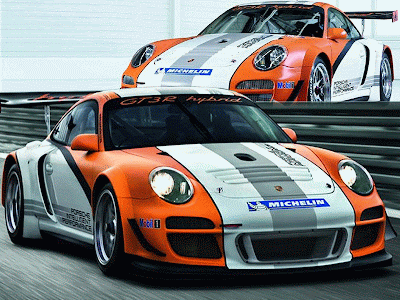
2010 Porsche Sports Cars 911 GT3 R Hybrid

Known as the 2010 Porsche 911 GT3 R Hybrid, the model hints at new hybrid technology that Porsche Sports Cars will use in its motorsport ventures. According to Porsche, the 911 GT3 R Hybrid will be used as a study to gather information about how hybrid drive will behave under a racing environment and will also help the German automaker study how it can be applied to its road cars.
2010 Porsche 911 GT3 R Hybrid
During Porsche's press conference here at the Geneva Motor Show, most of our attention was understandably on the 918 Spyder Concept, but the German automaker had several other significant debuts. One was the 911 GT3 R Hybrid, Porsche's first race car to feature electric power sourced from a duo of motors that send power to a generator attached the flywheel. Like many hybrid production cars, the motors are charged whenever the brakes are applied, and the driver can use the extra power for 6-8 seconds for overtaking.
Exactly 110 years after Ferdinand Porsche developed the world's first car with hybrid drive, the Lohner Porsche Semper Vivus, Dr. Ing. h.c. F. Porsche AG, Stuttgart, is once again taking up this visionary drive concept in production-based GT racing: During the Geneva Motor Show, a Porsche Sports Cars 911 GT3 R with innovative hybrid drive is making its debut, opening up a new chapter in the history of Porsche with more than 20,000 wins in 45 years scored by the extremely successful Porsche 911 in racing trim.
Unlike a conventional battery-electric hybrid system the Porsche 911 GT3 R uses a flywheel system, which gathers kinetic energy under braking to power two electric-motors that are mounted in a single assembly and are connected to the front wheel. After each boost of charge, the two motors provide 6 to 8 second jolts of power. The extra power is engaged by pressing a button on the steering wheel, providing up to 161-hp to the front wheels, assisting the 911 GT3 R Hybrid’s 480-hp 4.0L inline-6 that powers the two rear-wheels.
The innovative hybrid technology featured in the car has been developed especially for racing, standing out significantly in its configuration and components from conventional hybrid systems. In this case, electrical front axle drive with two electric motors developing 60 kW each supplements the 480-bhp four-litre flat-six at the rear of the 911 GT3 R Hybrid. A further significant point is that instead of the usual batteries in a hybrid road car, an electrical flywheel power generator fitted in the interior next to the driver delivers energy to the electric motors.
The flywheel generator itself is an electric motor with its rotor spinning at speeds of up to 40,000 rpm, storing energy mechanically as rotation energy. The flywheel generator is charged whenever the driver applies the brakes, with the two electric motors reversing their function on the front axle and acting themselves as generators. Then, whenever necessary, that is when accelerating out of a bend or when overtaking, the driver is able to call up extra energy from the charged flywheel generator, the flywheel being slowed down electromagnetically in the generator mode and thus supplying up to 120 kW to the two electric motors at the front from its kinetic energy.
This additional power is available to the driver after each charge process for approximately 6 - 8 seconds. Energy formerly converted - and thus wasted - into heat upon every application of the brakes, is now highly efficiently converted into additional drive power.
Depending on racing conditions, hybrid drive is used in this case not only for extra power, but also to save fuel. This again increases the efficiency and, accordingly, the performance of the 911 GT3 R Hybrid, for example by reducing the weight of the tank or making pitstops less frequent.
After its debut in Geneva the 911 GT3 R Hybrid will be tested in long-distance races on the Nürburgring. The highlight of this test programme will be the 24 Hours on the Nordschleife of Nürburgring on May 15th and 16th. The focus is not on the 911 GT3 R Hybrid winning the race, but rather serving as a spearhead in technology and a 'racing laboratory' providing know-how on the subsequent use of hybrid technology in road-going sports cars.
The 911 GT3 R Hybrid is a perfect example of the Porsche Intelligent Performance philosophy, a principle to be found in every Porsche: More power on less fuel, more efficiency and lower CO2 emissions - on the track and on the road.
 

blogger templates | c.r.a.m.a.t